The Great ADHD Myth? A therapist's response
posted 21st September 2026
TL; DR
- The programme makes two claims and never separates them; that we over-medicate children, and that ADHD isn't a neurodevelopmental difference. Evidence for the former isn't evidence for the latter.
- Its six-week experiment changed several things at once with no control, so it can't tell us what caused what.
- It gathers a great deal of support for the social model of disability, then concludes that the difference itself is fictional. That doesn't follow.
- An ADHD diagnosis does not automatically mean medication, and the programme skips titration entirely.
- Whatever the cause turns out to be, causation is not a debt people have to settle before they're allowed support.
I watched Channel 4's The Great ADHD Myth? braced for fury but actually it was less outrageous than the title promised, and I surprised myself by agreeing with some points raised. However, the parts I agree with are being used to carry a conclusion they cannot hold.
Is ADHD over-medicated, or does it not exist? Two arguments mashed together in one programme
The programme is really making two separate claims, and it never fully separates them.
The first is that we are over-medicating children. The second is that ADHD does not exist as a neurodevelopmental difference at all.
These are not the same argument, and evidence for the former is not evidence for the latter. You can believe, as the programme asserts, that medication is reached for too quickly and too often, in place of adequate support, and still believe that ADHD describes something real about how some brains work.
Setting both claims side by side, as this programme does, implies they support each other and lends credibility where none is evidenced.
An experiment without a control
The programme follows a ten-year-old boy who comes off his medication for six weeks while several other things change at once; less screen time, less ultra-processed food, more time outdoors, more sport and creative activity.
As television, it is compelling. As evidence, it tells us almost nothing, because there is no way to know which change did what. If he improves, was it the absence of medication? The removal of devices? The change in diet? Or the fact that a film crew was in his house and his mother was intensively engaged in his day?
MQ Mental Health made this point in their response: so many factors changed inside such a short and artificial period that no change in his behaviour can reasonably be attributed to stopping medication.
I would add that screens and ultra-processed food are themselves heavily funded areas of research and commentary. Pointing at industry incentives is a fair move. It just doesn't only point one way.
Where I agree: the social model of disability
The programme's strongest material is its argument that ADHD sits on the continuum of ordinary human variation, and that our schools and workplaces are not built for that variation.
I agree, and I would go further.
I am not disabled by my ADHD. I am disabled by the expectations of a neurotypical world I cannot compete in on like-for-like terms. That is not a statement of defeat, I have built a successful career and a thriving practice. But it does require a sometimes heavy burden of strategies and workarounds to reach a place someone else arrives at by default.
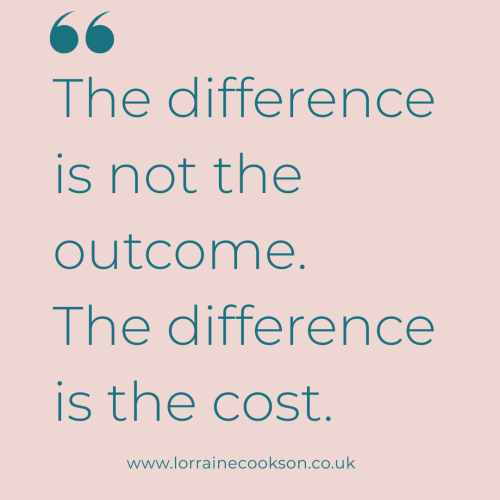
The difference is not the outcome. The difference is the cost.
This is the social model of disability, and the documentary gathers a striking amount of support for it. Which is what makes its conclusion so strange to me.
Does the cause of ADHD matter?
Suppose the cause is diet. Or screens. Or trauma. Or neurobiology. Or, most likely, some braided combination that differs from person to person. I am not a scientist, and I don't know.
In general, the question matters enormously. It shapes research, prevention, public health, how we design schools. I have no interest in shutting it down.
But it stops being a useful question the moment it is used as a precondition for support. Whatever the mechanism turns out to be, the person in front of me is struggling with the same cluster of experiences today. Settling causation is not a debt they have to clear before they are allowed accommodations, or medication, or a life arranged to suit how they actually function. We do not withhold anything else on those terms.
And what I see every week is this. People who find a group of experiences they have carried alone finally named. Who stop reading their own difficulty as a character flaw. Who can explain themselves to a partner or a manager, ask for what they need, and build strategies that fit the brain they have rather than the one they were told to have. People who hate themselves a little less.
That happens regardless of mechanism. If an argument about causation ends with a person losing the framework that lets them understand their own life, it has cost more than it discovered.
Do you need to be impaired to have ADHD? The presenter's own diagnosis
The presenter undergoes an assessment, receives a diagnosis, and then says he does not consider any part of his life disabled by it.
This is interesting, and it shows two things.
First, he is right that diagnostic categories are built on clinical opinion. The DSM is a document of judgement from a point in time based on the opinions and evidence shaped within a society not in a vacuum. I say the same to clients: every mental health diagnosis rests on a clinician's interpretation of the diagnostic criteria written down by a professional body heavily skewed to certain demographics, where we know not all societal variations may have been considered in the first place.
So, it is worth following his own logic through. The threshold requires significant impairment, and that impairment must not be better explained by something else. If he genuinely is not impaired, then on a strict reading he should not meet the diagnostic criteria. That is a real finding about how assessment is being conducted. It is not a finding about whether ADHD exists. I would also say I do not accept that threshold as the boundary of who does and does not have an ADHD brain.
Second, someone whose traits are real but non-impairing is not well placed to generalise from that position to everyone else. He describes having built strategies and workarounds, genuinely impressive, and not remotely unusual. Everyone I work with has done this. What differs is what else they are carrying while they do it.
Pair those same strategies with being socialised female, with chronic illness, with autism, with poverty, with a job that offers no flexibility, and the effort of keeping the workarounds running becomes actively harmful. Burnout is not a failure of strategy. It is what happens when the strategies cost more than the person has.
That he can sustain his without visible cost is not evidence that others have no practical strategies in place. It is evidence that his circumstances let him afford his.
Does an ADHD diagnosis mean medication? What the programme leaves out
A diagnosis does not automatically produce a prescription. Most of the people I work with have spent years, often the best part of a decade or more, suspecting, reading, adapting and coping before they ever reach assessment. By the time a diagnosis arrives they usually have a full toolkit already. Some of them then need something more. I feel this picture of a real lived experience is conveniently left out of the documentary.
Titration is skipped entirely. The programme shows a single dose, taken to see what it feels like. In practice, getting medication right takes months of managed adjustment to find the right drug at the right dose, and for some people it never works and is stopped. Compressing that into one tablet and a reaction to camera is not a fair representation of what patients go through.
There were no women, no girls and no adults with ADHD in the programme. MQ noted this too, and it matters, given how differently presentation and diagnosis play out across gender and across a life.
Worth knowing as well that the programme's most senior scientific contributor, Professor Katya Rubia, has since withdrawn her support, saying her long interview was cherry-picked to fit the framing.
Is ADHD a social construct? Where the reasoning breaks
The documentary makes a strong case that schools do not accommodate this kind of difference, that our systems are rigid, that we are asking children to be something many of them cannot be.
Then it concludes that ADHD is a social construct rather than a disorder of the brain.
That is 2 + 2 = 5. Everything gathered supports the social model of disability. The conclusion drawn is that the difference itself is not based in a physical reality of the brain, but evidence for the social model of disability is not evidence against a neurological difference. A consultant psychiatrist writing for Recognition Health made a similar point, that the programme collapsed a genuinely complex question into a binary in which either ADHD is a disorder or society is the problem, when the honest answer involves both.
One contributor proposed scrapping the label, taking children off medication, and then overhauling education. I would do it in the opposite order. Build systems that are fit for purpose and then see how much medication is still needed. Ask people to go first, unsupported, and you are simply removing help and calling it progress.
If we are pathologising ordinary human variety, and in some respects, I think we are, the answer is to rebuild the norms that cannot accommodate it, not to withhold the labels that help people survive them.
What the documentary actually proved
The boy stayed off medication at the close of the programme, but he went back on it two months later, after his exam results suffered.
However much more himself he may have felt, allowing his schooling to deteriorate unchecked was a gamble with his future. This is the actual dilemma parents are sitting with, and it did not require a televised experiment to surface. ADHD UK's complaint to Ofcom alleges that the programme held this result back, that he returned to medication and his work improved, until a caption shown after the presenter had already delivered his verdict.
And that verdict is the problem. He did not conclude that the evidence was unsettled. He concluded that ADHD is a social construct rather than a disorder of the brain, and nothing in the programme established that. No study was presented that ruled out a neurodevelopmental basis. A six-week experiment with no control, a panel of expert contributors edited to fit its scepticism, and a presenter's own untroubled diagnosis do not add up to that finding.
And I would ask what the finding was for. Because the practical effect of an hour of primetime television telling people their difficulties are a social construct is not more rigorous science. It is a parent second-guessing a prescription, and an adult on a three-year waiting list wondering whether to bother.
If you watched this and found yourself doubting
If the programme has left you wondering whether your struggles are legitimate, or whether you should have pursued an assessment at all: you deserve support, and a documentary is not the thing that decides whether you get it.
Understanding how your brain works has never made anyone less capable. It has, in my experience, made a great many people considerably kinder to themselves.
Questions people are asking about this
Is ADHD real?
Yes. The traits are real, the difficulties are real, and they are consistent enough across people and across a life to be recognisable. What remains genuinely open is the mechanism and that is a research question, not a gatekeeping one.
Is ADHD a social construct?
All diagnostic criteria in the DSM-5 for conditions diagnosed from observed and reported experience, rather than a blood test or scan, are constructed, in the sense that they are built from clinical judgement about what counts as a problem in a given society. It does not mean the experiences behind the label are invented, and the documentary did not show that they were.
Does an ADHD diagnosis mean you have to take medication?
No. Medication is one option among several, and many people never take it. In my experience most people arrive at assessment having already built years of strategies, and a diagnosis usually adds to those rather than replacing them.
Is ADHD caused by screens and ultra-processed food?
Reducing screen time and eating less processed food are good for most people, and I would support people doing this for themselves and their families. However, neither has been shown to cause or cure ADHD, and improvement following a change like this does not establish cause, particularly when several things change at once.
Should I still get assessed after watching this?
If you were considering it before, this programme is not a reason to stop. Understanding how your brain works does not make you less capable, and it is usually the thing that makes self-compassion possible.
Written by Lorraine Cookson, psychotherapist and clinical supervisor.
I have worked been working with clients for over 15 years and as a supervisor since 2017. I hold a Specialist Diploma in Neurodiversity Informed Psychotherapy, and I am AuDHD myself. If you would like to work with me, please get in touch.